

Abstract
Objectives
This study examined possible predictors of stroke [left atrial sphericity index (LASI), left atrial kinetic energy (LAKE), left atrial volume index (LAVI) atrial electromechanical delay (AEMD)] intervals in patients with micro-atrial fibrillation (micro-AF).
Patients and methods
A total of 102 consecutive patients (40 males, 62 females; mean age: 61.5±9.2 years; range, 18 to 75 years) diagnosed with micro-AF on rhythm Holter were included in this retrospective study between June 2021 and October 2021. Cranial magnetic resonance and computed tomography images of these patients were scanned from the hospital database. The patients were divided into two groups according to their stroke status (Group 1, the stroke group [n=25]; Group 2, the nonstroke group [n=77]). The LASI was calculated as a fraction of the left atrial maximum volume to the left atrial volume of the sphere in a four-chamber view. The biplane method of disks was used to calculate left atrium volume. The LAVI was calculated by dividing left atrium (LA) volume by the body surface area of patients. Atrial electromechanical delay intervals were calculated from the atrial walls by tissue Doppler imaging. These two groups were compared to assess whether echocardiographic parameters could be a predictor of cerebrovascular events.
Results
There was a statistically significant difference between Groups 1 and 2 in terms of left (75.7±4.5 vs. 68.4±3.5, p<0.001) and right (69.5±7.1 vs. 57±3.2, p<0.001) atrial lateral wall and LA medial wall (72±4 vs. 66.2±3.5, p<0.001) electromechanical delay times, LAVI (38.9±3.3 vs. 30.9±3.8, p<0.001), LASI (0.78±0.05 vs. 0.67±0.4, p<0.001), and LAKE (3.7±0.9 vs. 7.9±1.9, p<0.001), left atrial diameter (40±5 vs. 38±2, p<0.001).
Conclusion
Changes in LASI, LAVI, LAKE, left atrial diameter, and atrial AEMD times may be a predictor of stroke in patients with micro-AF.
Introduction
Atrial fibrillation (AF) is the most common type of sustained arrhythmia in clinical practice without P waves lasting a minimum of 30 sec.
Atrial fibrillation increases total and cardiovascular mortality by 1.5 to 2.5 times.[1] It has been determined that the development of AF causes a five-fold increase in the risk of stroke. It has been observed that AF-related strokes have a more severe course than non-AF-related strokes.[2]
Atrial fibrillation is associated with structural and chronic diseases, such as hypertension, chronic kidney failure, heart failure, heart valve diseases, congenital heart defects, ischemic heart disease, diabetes, chronic obstructive pulmonary disease, hyperlipidemia, obesity, and thyroid hormone disorders. Atrial fibrillation begins as a result of hemodynamic or structural changes in the left atrium (LA), and during the paroxysmal and persistent phase, LA dilatation occurs, and mechanical functions gradually deteriorate.[3] Understanding the structure and function of the LA can be helpful in predicting the risk of developing AF and shaping treatment. It is not possible to accurately measure LA volumes from two-dimensional linear measurements of LA since LA expansion usually does not occur uniformly in all directions.
However, although calculating LA volume using magnetic resonance imaging (MRI) and cardiac computed tomography (CT) gives more accurate measurements, these are time-consuming and limiting procedures due to kidney and radiation damage.[3] Therefore, measurements made with transthoracic echocardiography (TTE) are vital in daily practice.
Left atrial kinetic energy (LAKE) is a parameter that indicates left atrial mechanical function and can be calculated noninvasively with TTE.[4] Structural change in the atrium causes a delay between the electrical stimulation and mechanical contraction.
The atrial electromechanical delay (AEMD) is the time interval from the onset of the P wave on surface electrocardiography (ECG) to the beginning of the late diastolic wave on tissue Doppler (late distolic [Am] wave).[5,6] These structural changes also lead to a prolongation in P wave duration. Likewise, increases in the left atrial sphericity index (LASI) and left atrial volume index (LAVI) were also associated with increased AF recurrence.[7,8] The LASI was found to accurately indicate LA remodeling and accurately measure the spherical shape of the LA.[7]
Although there are many studies related to AF,[5,6] there are few studies on very short-lasting episodes of AF-like activity (micro-AF).[7,8] Sudden onset irregular tachycardia with ≥5 consecutive supraventricular episodes and a total absence of pulse and P waves lasting less than 30 sec have been defined as micro-AF in previous studies.[9,10]
Currently, there is limited information about the risk of shorter episodes of AF-like activity. Two studies have reported that supraventricular ectopic beats and supraventricular tachycardias may be associated with an increased risk of AF and stroke over time.[9,10] Currently, there are no recommendations on how to treat these patients. Hence, we examined possible predictors of stroke (LASI, LAKE, LAVI, and AEMD intervals) in patients with micro-AF.
Methods
A total of 102 patients (40 males, 62 females; mean age: 61.5±9.2 years; range, 18 to 75 years) diagnosed with micro-AF by 24-h rhythm Holter monitoring were included in this retrospective study conducted at Faculty of Medicine Namık Kemal University, Department of Cardiology between June 2021 and October 2021. Clinical data were obtained by examining the database of our hospital. All blood samples of the patients were taken after 12 h of fasting. Patients diagnosed with paroxysmal AF in rhythm Holter monitoring, patients with structural valve disease, heart failure, thyroid hormone disorder, significant coronary artery disease, and a history of atherothrombotic stroke, lacunar infarction, or transient ischemic attack were excluded from the study.
In 24-h Holter monitoring (Schiller MT-101; Schiller AG, Baar, Switzerland), sudden onset of irregular tachycardia with ≥5 consecutive supraventricular episodes and the total absence of pulses and P waves lasting <30 sec was described as micro-AF. The patients were divided into two groups according to their stroke status (Group 1, those with stroke [n=25]; Group 2, those without stroke [n=77]).
As a result of the examinations made in the database of our hospital, the diagnosis of stroke was made according to patient history, physical examination findings, cranial CT, and cranial MRI. Carotid Doppler ultrasonography, CT, or MRI angiography results of stroke patients were scanned to exclude the diagnosis of atherothrombotic stroke.
All patients underwent routine TTE with Vivid 5 (GE Healthcare, Wauwatosa, WI, USA) and an M4S Matrix array adult cardiac (3.5 MHz) probe on the lateral decubitus position. All assessments and measurements were made according to the European Association of Cardiovascular Imaging (EACVI) guidelines.[11] The area-length technique was used to calculate the LA maximum volume (LAV). Pulmonary veins and atrial appendages were not included in the measurement. Left ventricular ejection fraction was calculated according to the modified biplane Simpson method. The LAV and LA volume of sphere were calculated according to the following formulas: LAV=(0.848¥LA area4chamber¥LA area2chamber)/ (minimum LA length/2);
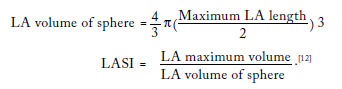
The LASI was calculated as the ratio of LAV to LA volume of sphere. Left atrial kinetic energy was defined as 0.5×LA stroke volume (cm³, volume at the beginning of left atrial systole-LA minimal volume) × 1.06 (g/cm³, blood density) × (peak A velocity)².
In apical four-chamber view, pulse wave Doppler with a 3 mm sample volume was placed at the mitral leaflet tips, then the peak E and A waves were measured. Tissue Doppler imaging was performed on atrial walls in apical four-chamber view. The time interval from the onset of the P wave on ECG to the beginning of the Am wave was measured for AEMD from the atrial wall (Figure 1).
AEMD: Atrial electromechanical delay.
The time interval from the onset of the P wave on surface ECG to the beginning of the Am wave on tissue Doppler imaging was identified as AEMD (Figure 1a, b).[7] Atrial electromechanical delay intervals were defined as follows: lateral LA wall (LA lateral AEMD), interatrial septum (LA medial AEMD), and lateral right atrium (RA) wall (RA lateral AEMD). The differences between the LA lateral AEMD and RA lateral AEMD time intervals were expressed as inter-AEMD. Left intra-AEMD (intra-AEMDLEFT) was defined as the difference between LA lateral AEMD and LA medial AEMD.
Right intra-AEMD (intra-AEMDRIGHT) was defined as the difference between LA medial AEMD and RA lateral AEMD.
Statistical analysis
All data were analyzed using the IBM SPSS version 22.0 software (IBM Corp., Armonk, NY, USA). Continuous variables with a normal distribution were reported as mean ± standard deviation (SD). Nonnormally distributed continuous variables were presented as median. Categorical variables were reported as percentages. Student's t-test was used to compare normally distributed data, and the Mann-Whitney U test was used for nonnormally distributed data. Categorical variables were compared using the chi-square test or Fisher exact test as appropriate. Univariate and stepwise logistic regression analyses were used to determine significant predictors of stroke in patients with micro-AF. The relationship between AEMD durations. LAVI, LASI, and LAKE was investigated using Pearson’s correlation tests. The sensitivity and specificity of LASI, LAVI, LAKE, and AEMD durations to predict stroke in patients with micro-AF were analyzed by receiver operating characteristics (ROC) analysis. A p value <0.05 was considered statistically significant.
Results
The baseline characteristics of the patients were statistically similar, except for the CHA2DS2-VASc (C; Congestive heart failure, H; Hypertension, A2; Age ≥75 years, D; Diabetes mellitus, S2; Stroke, V; Vascular disease, A; Age 65-74 years, Sc; Sex category) score (Table 1). The CHA2DS2-VASc score was significantly higher in Group 1 than in Group 2 (4±1 vs. 2±1; p<0.001).
The AEMD times measured from atrial walls in Group 1 were longer (p<0.001). While the duration of intra-AEMDLEFT was longer in Group 1 than in Group 2 (4.56±2.04 vs. 3.78±1.53; p=0.039), inter-AEMD and intra-AEMDRIGHT times were similar in both groups (Table 2). The LAVI (p<0.001). LASI (p<0.001), and LA diameter (p<0.001) were statistically higher in Group 1.
Left atrial kinetic energy was lower in Group 1 than in Group 2 (3.7±0.9 vs. 7.9±1.9; p<0.001). All other echocardiographic measurements were similar between the two groups.
In bivariate correlation analysis, a positive moderate-high level of correlation was observed between LASI and stroke (r=0.67, p<0.001). A positive high level of correlation was observed between AEMD times and stroke and LA medial AEMD (r=0.74, p<0.001), LA lateral AEMD (r=0.78, p<0.001), and RA lateral AEMD (r=0.78, p<0.001, Table 3). A high level of negative correlation was observed between LAKE and stroke (r=-0.71, p<0.001). In univariate logistic regression analysis, LASI, LAVI, LAKE, AEMD times, and CHA2DS2-VASc scores were significant predictors of stroke in micro-AF (p<0.001 for all, Table 4).
In the stepwise logistic regression analysis, LAVI, LAKE in model 1, LAVI in model 2, LA diameter in model 3, CHA2DS2-VASc score, LA lateral AEMD, LA diameter in model 4, LAKE, CHA2DS2-VASc score in model 5, LA diameter, LA diameter in model 6, CHA2DS2-VASc score, and LA lateral AEMD were independent predictors for stroke (Table 5).
Lastly, a ROC analysis was performed to evaluate the predictive power of LASI, LAVI, LAKE, and LA lateral AEMD for stroke in patients with micro-AF (Figures Figure 2 and Figure 3; Table 6). The area under the curve and cut-off values were calculated for each parameter as follows: LASI (0.95, cut-off >0.71, p<0.001), LAVI (0.98, cut-off >36, p<0.001), LA lateral AEMD (0.97, cut-off >70.4, p<0.001), LAKE (0.97, cut-off ≤5.5, p<0.001).
Discussion
This study investigated the significance of LASI, LAVI, AEMD, and LAKE indicators of left atrial electromechanical function as stroke markers in patients with micro-AF. Although there is a significant body of studies on stroke in patients with AF, these markers have not been studied before in a group of patients with micro-AF. Patients with atherothrombotic occlusion, lacunar infarction, and transient ischemic attack were also not included in our study, whereas patients with a high probability of cardioembolic stroke were included.
In a cohort study of ablated AF, the LA sphericity index was found to be an independent risk factor for arrhythmia recurrence.[7] In another study, patients with more spherical LA also had a more frequent history of thromboembolic events.[13] In a different study, healthy patients with 30 or more supraventricular ectopic beats had a three-fold increase in AF prevalence and a 60% increased risk of stroke and death after 6.3 years.[9] In the study by Tove Hygrell et al.,[14] the micro-AF group also had the highest cumulative incidence of stroke (4.1%) and death (10.3%). In previous studies, the prevalence of AF was found to be more than four times in the micro-AF group (13%) compared to the control group (3%).[7] Increasing LA pressure and volume for various reasons causes changes in LA shape.[11] The LA tries to provide optimum volume/surface area by becoming more spherical as an adaptation mechanism to reduce wall stress. Increased LA pressure expands the atrium along the atrial orthogonal axis, causing the shape of the atrium to change from oval to spherical.
Since the LA expands by different amounts in the three-dimensional plane, the LA volume and sphericity index can measure LA dimensions more accurately than linear measurements of LA.[11] Methods such as MRI and cardiac CT are invaluable for assessing asymmetric changes in LA.[11] However, the radiation exposure and time-consuming nature reduce the usability of these processes.
We observed that a higher LASI and LAVI, which means a more spherical LA, increases the risk of stroke. Therefore, close follow-up of patients with micro-AF with high LASI and LAVI in terms of stroke is essential. Deconstructed LA is more prone to the development of AF.[7] Left atrial kinetic energy, which is an important indicator of LA mechanical function, also decreases over time. Left atrial kinetic energy has been observed as a predictor of AF recurrence, independent of the LA diameter.[7] This proves that it is wrong to evaluate LA function by LA diameter alone, While electrical remodeling starts early in the AF process in the atria, structural remodeling is a late histopathological manifestation.[7]
The duration of AEMD is closely related to the histopathological changes in the atrium.[12] In particular, as reported in previous studies, the delay time in this conduction is greater in the lateral walls of the LA and left ventricle, which are further away from the sinus node.[7,15,16] Park et al.[15] found left atrial volumes and AEMD durations to be longer in patients with AF recurrence, supporting our study. In the study of Osmanagic et al.,[16] when the LASI value was taken as 0.9, the specificity was 79.3% and the sensitivity was 51.8% in predicting AF recurrence. Similarly, LASI was significantly higher in stroke patients with micro-AF in our study (0.78±0.05 in Group 1 vs. 0.67±0.04 in Group 2; p<0.001). It is important to provide rhythm control in the early period to prevent LA geometric remodeling and cardiovascular events that may occur due to AF. Predictors such as AEMD, LASI, LAKE, and LAVI will help us in early diagnosis before AF becomes permanent. In our study, we emphasized the importance of these indices in predicting stroke risk in patients with micro-AF.
How AF burden affects stroke risk is an ongoing discussion. A meta-analysis of studies in patients not using oral anticoagulant (OAC) therapy shows that patients with more persistent forms of AF rather than paroxysmal have a higher risk of stroke.[17] Atrial fibrillation progresses from the paroxysmal form to more permanent forms over time, and this situation increases with increasing age.[18] It is not known if high-risk individuals with micro-AF would benefit from OAC. However, these patients may benefit from risk-free interventions, primary prevention, optimizing lifestyle factors, and treating comorbidities as an effort to reverse atrial myopathy.
In the study by Binici et al.,[9] healthy individuals aged 55 to 75 years who underwent 48-h ECG monitoring were analyzed for supraventricular tachycardia (≥20 beats) and ≥30 supraventricular ectopic beats per hour. At the 6.3-year follow-up, they found a three-fold increase in the risk of developing AF and a 60% increase in the risk of death compared to the control group. It was determined that the number and duration of supraventricular beats were directly proportional in the development of AF.
According to this study, OAC should not be started in patients with micro-AF and low supraventricular beats with a high risk of bleeding. In a Swedish cohort study, individuals free from AF were followed prospectively for >13 years.[19] Irregular SVTs without P waves showed the strongest association with clinical AF, with a cumulative incidence of 47.4%. Judging by studies and meta-analyses, there is no consensus on the treatment approach in patients with micro-AF.
Oral anticoagulant therapy may be started in patients with micro-AF with a high CHA2DS2-VASc score, but prospective comprehensive studies are needed. Comprehensive multicenter studies to be conducted in the future may lead to early initiation of medical treatment in patients with early AF risk. Therefore, these predictors are important in diagnosis and follow-up.
There are several limitations to this study. First, it was a single-center retrospective study with a small number of patients. Due to limited number of patients, the study cannot be attributed to the entire population. Second, there was a difference between the two groups in terms of the number of patients.
Additionally, cardiac MRI and CT methods could be used in addition to TTE for LAVI and LASI calculations in patients with poor image quality.
Lastly, longer Holter monitoring or a loop recorder could be fitted for patients with micro-AF on 24-h Holter recordings to detect paroxysmal AF attacks.
In conclusion, early diagnosis and treatment of micro-AF, which is the predictor of AF in the long term, is crucial. We can identify and treat these patients who are at risk of cardioembolic stroke with easily calculable indices. These new parameters may contribute to other parameters, such as CHA2DS2-VASc score and atrial diameters, in predicting cardioembolic stroke.